
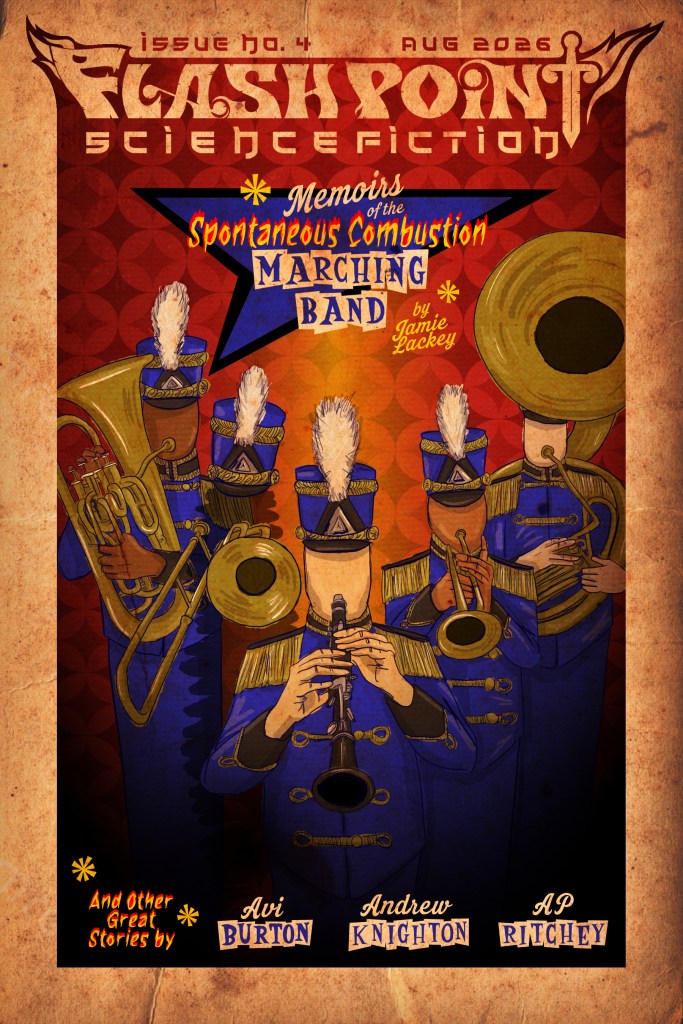
flashpointsf / August 28, 2026/ Full Issue

Issue #4 2026

Table of Contents:


Memoirs of the Spontaneous Combustion Marching Band
by Jamie Lackey


Sometimes you just want to be a part of something. Something bigger than yourself, something that matters. Even if everyone tells you that it’s an idiotic, dangerous idea. Even if they’re right. 

The first time I heard the marching band was a hot summer day, and the air was heavy with the threat of rain and the scent of fried foods. They were performing at the fair, parading past sleeping cows and overheated sheep, feet moving in unison, creating sounds rich with elements that I’d never experienced before. 

Melody, harmony, rhythm. I knew the words, but had never understood them before that moment. 

I felt the music in my bones, and it slipped between my ribs and right into my heart. 

They all looked so determined in their matching red uniforms and absurd hats, so focused and present and sweaty and real, and then one of the flutists launched into a shimmering, soaring solo, and I ached with jealousy, with wanting be able to do that, to make music out of metal and air. 

Then there was an orange flash and a wave of dry heat, and one of the trombone players was gone. His singed hat fell to the ground, next to the twisted metal that had, just seconds ago, been an instrument. 

The rest of the band kept playing, kept marching without missing a single step. 

They all knew the risks. 


“I know the risks,” I said, hugging a flute to my chest. “I want to play.” I more than wanted to play. I needed to play.  

Miss Charleton, the band director, slid a slip of paper across her desk to me. “You’re underage. I can’t let you take that without a parent’s signature.” 

My parents didn’t understand. My mother was in favor of banning music altogether, of burning every instrument before anyone else combusted. My father insisted that listening to podcasts was better than music ever was. 

I forged my father’s signature and told my parents that I’d joined the track team. I think Miss Charleton suspected, but she didn’t call me on it. 

She understood. And she always needed more flutists. 


There was one other new girl in the flute section. We exchanged nervous smiles and commiserating glances when our first notes came out breathy, shrill, unstable. Her name was Viola, which was funny, because apparently she’d never known there was an instrument called that and was just named after her great-aunt. 

We didn’t have any string instruments in the band. We had no idea what a viola sounded like. But we learned the rattling tap of the snare drums, the brassy song of the trumpets, the bright voice of the clarinets. 

There was a thrill to playing, a shivery adrenaline feeling every time I put my flute to my lips. No one could predict when someone might combust, and it wasn’t that common. We only lost someone every year or two. Right after I joined, we went a full three years without losing anyone. Miss Charleton was almost thirty, and she’d been playing since she was a kid. 

But it wasn’t the fear that kept us coming back to the band room. It was the feeling of connection, of creating something together that was more than the sum of its parts. I loved playing alone, but playing with the band was magical. 

Sometimes, Viola and I would play duets. 

In the spring of our junior year, she slipped her hand into mine on the bus on the way home from a concert. Her palm was sweaty, but I never wanted to let go. She leaned her head against my shoulder and settled there, warm and soft, like a kitten. 

I watched her sleep in the sporadic splashes of streetlights that fell through the bus window. She was so beautiful that it made my heart hurt. I thought about quitting the band, of dragging her with me, of keeping her safe. 

I still didn’t know what a viola sounded like. 

And as much as I loved her, I loved music more. 


My parents didn’t make it to a track meet till my senior year—I didn’t blame them, watching people run around in circles didn’t sound like fun, and they were busy keeping food on the table and a roof over our heads. 

They saw me coming out of the band room. I had no contingency plan, no excuse. I was still carrying my flute case. 

I expected screaming and recriminations, anger and blame. I wasn’t prepared for my mother to break down in tears, for my father to look twenty years older as he pulled her into his arms. 

“It’s dangerous,” my mother sobbed. “You could die.” 

I hugged my flute to my chest, still afraid that they would try to take it away from me. “I know,” I said. “I know the risks. But I still want to play.” 

“Absolutely not,” my mother said, finally starting to look angry. 

“I’m 18 now,” I said. “I don’t need your permission.” 

I expected them to yell some more, to threaten to kick me out of their house if I didn’t bend to their will. Instead, they just sagged, like marionettes with their strings cut. “When did you start?” my father asked. 

“In sixth grade.” 

The fight drained out of them. We didn’t talk about the band again. But my parents never missed a performance, after that. 


Music is dangerous. I know that. But life is dangerous. People get hit by busses or drown or get sick. Music kills fewer people each year than heart disease or cancer or accidents or even diabetes. 

Melody, harmony, rhythm. They’re part of me, and I won’t give them up. Not for my parents, not for Viola, not for myself. 

I pick up my flute and bring it to my lips. And maybe there’s a flash of heat, and a few fading notes and a singed hat are all I leave behind. 

I accept the risks. 

About the author:

Jamie Lackey lives in Pittsburgh with her husband and their cats. She has had over 200 short stories published in places like Beneath Ceaseless Skies, Apex Magazine, and Escape Pod. She has two novellas and two short story collections available from Air and Nothingness Press, and she’s created eight successful crowdfunding campaigns to self-publish a novel, four novellas, a novelette, and four short story collections. In addition to writing, she spends her time reading, playing tabletop RPGs, baking, mushroom hunting, and hiking. You can find her online at www.jamielackey.com.

Find Jamie:
Facebook
Bluesky
Instagram


No Harm Done
by AP Ritchey


Mara’s house had become too quiet. The kind of quiet that drapes itself over furniture like dust. People called, at first. Neighbors brought food. But in the end, it was only the quiet that stayed.

She had never lost anyone before. Even her grandparents were alive. So she was not prepared for that cruel, ice-cold void, the brutal finality of death. 

No going back.  No more words. 

That was the part that took people’s breath away.


The day the man came, she had not invited him. When she opened the door, he said quietly, “Lydia sent me.”

Lydia. Of course.

The man followed her inside, glanced around the living room, taking in the soft clusters of houseplants. “Beautiful,” he murmured before introducing himself as Evan. No company name, no card. “I understand your husband passed three months ago. I’m sorry.”

Something in Mara’s throat tightened. “I don’t know what Lydia told you, but I don’t… I’m not looking for a medium.”

“Nothing so supernatural.” Evan smiled. “I work with… well. Think of it as interventional continuity technology.

Her face was blank.

“What happened to your husband was a one-in-a-million fluke. Those odds create an opportunity.”

“Opportunity?”

“Mara, your husband is alive and well.” 

Her hands went cold.

“But, elsewhere,” he continued. “We can now access a nearly infinite web of timelines. Parallel universes.”

Mara stared at him. The words were madness, but he was clearly not kidding.

“In those universes closest to ours, there are countless men who are, in every conceivable way, your husband,” Evan said. “No difference whatsoever, except they are alive.”

“What exactly are you saying?”

“We can bring him here. You can have your husband back.”

The room seemed to tilt.

“Get out.”

Evan didn’t argue. “Of course. But if the loneliness gets too heavy, call me,” and set a slip of paper on the table. Then let himself out.

Mara threw the paper away. Then pulled it out of the trash and shoved it into a drawer. Then reopened the drawer almost every morning.

Never dialing.

Just touching it.


Her days blurred into a slow rhythm of misting leaves, adjusting pots to catch the morning sun. Her pothos flourished. Her monstera pushed out new leaves like shy green hearts. She had begun talking to them.

“What was Lydia thinking?” she would ask them. “Alternate universes? Bringing him back? Can you even imagine?”

But, after a month of talking only to her plants and the occasional cashier, she called. 

It was short. Evan didn’t say I knew you would. He only said, “I’ll come by tomorrow.”


He arrived at noon, carrying nothing— no briefcase, no futuristic device to justify the unbelievable thing he promised.

“Let me explain what will happen,” Evan said, settling in her living room. “We have identified your husband — a version of him —  perfectly aligned with your shared history. The only difference is that in his reality, he wasn’t the victim of a one-in-a-million fluke.”

Her heart clenched like a fist.

“Will he know?”

“No. In almost every way, this world is identical to his. He will accept it seamlessly.”

“But how—”

“We initiate the transfer overnight, while he sleeps,” Evan said. “Waking up in a new universe is safer than being pulled across during, say, your evening commute. When you wake up tomorrow he will be here.” 

That made her stomach jump. 

“I’ll return around lunch tomorrow. If he’s right for you, you keep him. If not, he goes back tomorrow night, no harm done. We recommend confirmation questions. Things that prove your shared history. Nothing obvious, like his favorite color. Think of improbable happenings. Things with long odds.”

“There was a charity raffle last year. We won an ugly lamp.”

“Perfect. Ask him about it.”

He stood. She stood. He offered his hand and she took it. “One last thing. If he happens to see me, just say I’m a coworker dropping off papers.” 

Her half smile betrayed a seam of worry. He gave her hand a gentle squeeze.

“Don’t worry. You will get him back.”


She didn’t sleep so much as collapse. Her dreams were unsettled and at one point she felt the bed shift. But when morning came, she woke to a warmth beside her. A familiar body curved against her. A hand draped on her waist, and his smell—oh god, had she forgotten what he smelled like? 

He was there. Alive. Breathing. Then he spoke.

“Mara?” he murmured. “Sweetheart? Are you okay? You’re— why are you crying?”

He levered himself up to his elbow and reached over, wiping a tear from her cheek with such gentle care she only sobbed harder.

“I’m just happy,” she managed. “I’m just… so happy.”

He kissed her forehead.

It was exactly right.

All morning, they moved together in familiar patterns: coffee, making the bed. He laughed the same laugh. Touched her in the same affectionate way.

She didn’t even have to ask the question.

“That hideous lamp from the charity raffle,” he said with a smile. “I was thinking maybe it deserves another chance. Do you know where it is?”

“Of course,” she breathed, dizzy from the flood of love chemicals in her brain.

Everything was perfect.


When someone knocked at noon, she stiffened.

Her husband answered the door before she could stop him. She stepped quickly into the hallway and froze.

Her husband was standing there, speaking to Evan.

Comfortably.

Her husband turned, smiling warmly.

“Honey, it’s nothing. Just a friend from work dropping off some papers.”

An ice cold thread crawled up her spine.

Evan looked at her, unreadable.

Her gaze drifted past the men, alighted on the shelf.

Her heart stopped.

The pothos—months of tending—was shriveled and brown. The monstera drooped from neglect.

She felt her body collapse against the wall, slide down to the floor.

“Honey, are you okay?”

The room began to spin. Black spots filled her vision. 

“It’s okay, Mara, you’re home now.”

About the author:

AP Ritchey is a writer of speculative fiction and poetry from Fayetteville, Ark. His work has appeared in 4lph4num3r1c, Club Chicxulub, Eye to the Telescope, Nunum, SciFi Journal, SciFi Shorts, and Zodiac Review, among dozens of others. He is also a professional graphic designer, multi-instrumentalist, board game inventor and an accomplished printmaker.

Find AP Ritchey:
Website


Phineas Gage Went to Work With A Hole In His Head
by Avi Burton


Hi! I’m Anastasia. I’m here for the twelve o’clock interview…? Yes! That’s me. So nice to meet you. I’m super grateful for this opportunity. Ever since I was a little girl I wanted to be a junior assistant corporate copywriter. Digital-based marketing initiatives are my passion in life.

My resume—yes, okay, you have it on your computer. Great. I’m so excited to be here. I think I’d be a great fit for this company. 

As you can see on my resume, I graduated from New York University with a degree in communications, and after that I began work as an intern for—

Uh, yeah, only from January to March…I got sick. I had to leave the internship a little earlier than I intended. But I learned a lot of valuable skills, and—
No, I’m all better now! No longer contagious! Ready to jump back into the workforce!

So, the next point on my resume. While I was recovering from my illness, I did some volunteering. Mostly work-from-home stuff. I wrote marketing copy for various charities, like the Dying Orphans Initiative, the Saving Sick Chinchillas Foundation, uh…
Yes, I guess you could say I have a passion for medical causes, ha ha. Everyone’s got something, right?

No, it’s not because of—oh, fuck!

Oh my god I’m so sorry. I’ll fix that right away. Don’t worry, it just pops right back in. Happens all the time. It doesn’t even hurt. Like, I barely notice it anymore! And now there’s blood on your desk. Great. Oh, shit—sorry, swearing, oh my god this is so unprofessional, sorry—here, I’ve got wipes in my purse. 

Well, anyway, that’s why I couldn’t work for a bit. It’s really not as bad as it looks. 

…Sorry.
Why am I here? Um. This place is just so inspiring. It feels like there’s some new genius piece of advertising coming out every day. I want to be right in the middle of the action. I think I’d be a great fit for the company culture, too—

Oh. Like, why am I interviewing for a job at all? Well, uh. It’s just…the world doesn’t stop turning just because you’re a zombie, you know? Even a gal with her fingers falling off needs to eat. Especially if you’ve got your fingers falling off, actually, because then the medical bills are huge. And this place has such great healthcare benefits! But it’s not the benefits that I’m after, though, obviously, I just think it speaks to the company culture, right? You guys take care of your employees. I’m looking for a place that offers long term stability. That’s what matters to me.
No! I’m not dying.

….Sorry, that came out more aggressive than I meant. I apologize. There’s so many misconceptions and microaggressions about post-terminal diagnoses. Not that you microaggressed me, of course. You’re fine. 

Like I told you, I’m not dying. Technically, I am already dead. 

I promise won’t interfere with my ability to do the job. I don’t need any accommodations or medical leave. You saw it—the finger just pops right back in, no big deal. I’d be at a computer most of the time, anyway. So no need to worry about clients seeing, uh…me.

I’m not decaying, either. I know that’s a stereotype about people like me. Just think of it as a skin condition. Eczema or something. 

Okay, yeah, it’s a little more serious than eczema.

I died, um…about six months ago. Came back three weeks after that. My rent was overdue and my landlord had taped an eviction notice to my door. I guess no one had told him I was dead? Funny, right?

I did a brief stint in retail, but, uh, yeah, customer-facing jobs aren’t really…

No, go ahead, ask. It’s fine. Everyone wants to know. 

It was dark. Like being wrapped in a weighted blanket—warm, enclosed, just a little too tight to be comfortable. There might have been more than that, but I don’t remember. I can’t tell you if God is real. Take it up with your local religious authority. 

Kind of a letdown, I know. But that’s not my fault. 

Yeah, so. I’ve worked with Canva, Mailchimp, Hootsuite, et cetera. I’m familiar with Adobe Premiere and Photoshop. I included some examples of my social media work in my portfolio, if you want to take a look…

I died because I was sick. It happened pretty fast. I don’t really want to get into the details. I can get all the documentation that you want, though.

Apology accepted. Can we get back to the interview, please?

Thank you.

I would say my greatest weakness in the workplace is…sometimes I struggle to connect with people. Like I’m talking, but no one is listening? As if there’s plexiglass between us, or I’m on a bad Wi-Fi connection, glitching in and out. Post-mortem, everything feels brighter, smells sharper, but I’ve become faded. There’s just this hollow pit in my stomach. Hunger that’s not hunger. Drive that’s not drive. An emptiness that aches. But maybe everyone feels that way, in this economy?

No. Wait. Sorry! Can I change my answer?

My greatest weakness is that I’m a perfectionist. I just work too hard, ha ha!

And my greatest strength in the workplace is my resilience! I can adapt to anything. I’ve been through hell and back, and I’m confident that I will—

…no. It’s just an expression. Come on. 

Never mind. Forget it. 

Thanks again for the opportunity. I would shake your hand, but uh…yeah, maybe not. Better safe than sorry. 

When can I expect to hear back from you guys?

Okay, cool. 

I don’t mind waiting. I’ve got the rest of my life to wait.

About the author:

Avi Burton (they/he) currently moonlights as a writer and daylights as a different, more boring writer (marketing). Their work has appeared in Fantasy Magazine, Escape Pod, and other literary magazines. When not writing, they can be found backstage, battling QLab and scrawling strange runes in the sound booth.You can find more of Avi’s work on their website, www.aviburton.com, or on bluesky, @aviburton.bsky.social.


The Saint of the Baking Aisle
by Andrew Knighton


Not realising that it might be the final time, John took a tissue from his pocket, checked that the aisle was clear, and sprinkled out an offering of cake crumbs. He named the ingredient he needed, and there it was among shelves of self-raising flour, a single bag of spelt.

He’d first found faith when he was young, doing the weekly shop with his Mum. Already, the shelves were losing their variety, multicoloured packaging hiding identical contents. Seventeen brands of refined white sugar, one space for muscovado, and no other sweeteners. The problem wasn’t unique to the baking aisle—orzo only appeared in over-priced packets—but the baking aisle was shrinking, and that made the problem worse.

“No one bakes for themselves these days,” Mum had said, shaking her head. “Where do they even keep the bicarbonate?”

Young John, eager to go watch cartoons, flicked crumbs from his pullover and dismissively whispered the word “bicarbonate”.

“There it is!” Mum said, grabbing a plastic jar. “Well spotted.”

It took him a while to work out the rules, but as he did so, shopping got shorter. He would pick out a clump of ice to appease the freezer cabinet or release a held breath of fresh air for the vegetables. These small steps fed the demands of the shopping list, which saved time for comics or a kick around in the park. None of the shop staff seemed to know, and if they looked confused by the contents of Mum’s basket, that didn’t stop them making a sale. As long as the god of the baking aisle blessed them, his Mum could make what she wanted.

When he got older and Mum got sick, he weighed up the offerings differently. Between hospital visits and bed rest, trips to the shops meant time spent with Mum, who enjoyed the chance to feel useful. John’s aim wasn’t to get around quickly any more. Instead, he prayed for ingredients she forgot, making them pop up in her eye line at the perfect moment. Learning recipes meant he could finish baking too, when she got tired. Fresh bread and cakes reminded her of her own mother, which made her smile, right until the end.

Left alone in the house where he’d cared for her, John was surprised to realise that he enjoyed baking for himself. There was satisfaction in the work and in eating something he’d made. Mum had led him through a lesson she didn’t know how to explain.

Back in the supermarket aisle, the spelt flour weighed down John’s hand. His spirits had barely risen since the funeral, but today held an extra portion of grief.

“Grab what you can,” said a woman wearing the shop’s colours. “All that baking stuff’s being replaced with lager and baked beans.”

“Why?” John croaked.

“Not enough people baking.” She shrugged. “Shame, really, but head office demands sacrifices for efficiency.”

That was where the extra sadness had come from, the god of the aisle mourning his own end. John’s sorrow poured into the mix. How many of his most precious memories were baked into this place?

He’d never been the sort to stir up a fuss, and what could one outraged shopper do in the face of a national chain? It wasn’t like he could claim that this corner of a shop was his temple. He’d sound deranged.

Once the shop assistant was out of earshot, he leaned in close to the shelves.

“What can I do?” he whispered. The god had given him so much, he owed them one last sacrament.

But the god always worked in silence, and he kept his council now.

The bag of spelt flour burst beneath John’s fingers, pale dust filling the air like the softest smelling incense. A breeze blew unexpectedly down the aisle, caught the cloud, and drew it along with John’s gaze to a sign resting against the shelves, recently detached from the ceiling. Bright red and yellow letters paid tribute to “HOME BAKING”.

Thinking through consequences might have stopped John, and he couldn’t let that happen. Instead, he grabbed the sign and rushed down the aisle, dodging trolleys, heading for the exit.

“Here,” someone shouted, “you can’t take that.”

John tossed his basket aside and dashed past the confused security guard, out through the automatic doors into a concrete wilderness. He ran like he’d done when he was a kid, lighter on his feet than he’d been in far too long. The god of the baking aisle went with him, carried along in the sign.

When they got home, John put the sign behind Mum’s urn on the kitchen mantelpiece. Then he tipped a few crumbs from the biscuit tin and laid them out in a neat row.

When he’d felt sad as a kid, Mum liked to cheer him up with chocolate cake. It seemed like the right choice now.

“Cocoa powder,” he whispered, and opened a cupboard door, knowing that his god would provide.

About the author:

Growing up, Andrew Knighton’s goal was to go on fantastical adventures in impossible worlds. When that didn’t work out, he started imagining the adventures instead, and a writer was born. He’s now the author of the Forged For Destiny and Executioner series, as well as assorted short stories, comics, novellas, and murder mystery games. He lives in Yorkshire with an academic and a cat, growing vegetables and striving for a brighter future, while still hoping that a magical portal will open between the broad beans. You can find more of him at andrewknighton.com.

Find Andrew:
Bluesky
Instagram


RECENT STORIES

Table of Contents:


Memoirs of the Spontaneous Combustion Marching Band
by Jamie Lackey


Sometimes you just want to be a part of something. Something bigger than yourself, something that matters. Even if everyone tells you that it’s an idiotic, dangerous idea. Even if they’re right. 

The first time I heard the marching band was a hot summer day, and the air was heavy with the threat of rain and the scent of fried foods. They were performing at the fair, parading past sleeping cows and overheated sheep, feet moving in unison, creating sounds rich with elements that I’d never experienced before. 

Melody, harmony, rhythm. I knew the words, but had never understood them before that moment. 

I felt the music in my bones, and it slipped between my ribs and right into my heart. 

They all looked so determined in their matching red uniforms and absurd hats, so focused and present and sweaty and real, and then one of the flutists launched into a shimmering, soaring solo, and I ached with jealousy, with wanting be able to do that, to make music out of metal and air. 

Then there was an orange flash and a wave of dry heat, and one of the trombone players was gone. His singed hat fell to the ground, next to the twisted metal that had, just seconds ago, been an instrument. 

The rest of the band kept playing, kept marching without missing a single step. 

They all knew the risks. 


“I know the risks,” I said, hugging a flute to my chest. “I want to play.” I more than wanted to play. I needed to play.  

Miss Charleton, the band director, slid a slip of paper across her desk to me. “You’re underage. I can’t let you take that without a parent’s signature.” 

My parents didn’t understand. My mother was in favor of banning music altogether, of burning every instrument before anyone else combusted. My father insisted that listening to podcasts was better than music ever was. 

I forged my father’s signature and told my parents that I’d joined the track team. I think Miss Charleton suspected, but she didn’t call me on it. 

She understood. And she always needed more flutists. 


There was one other new girl in the flute section. We exchanged nervous smiles and commiserating glances when our first notes came out breathy, shrill, unstable. Her name was Viola, which was funny, because apparently she’d never known there was an instrument called that and was just named after her great-aunt. 

We didn’t have any string instruments in the band. We had no idea what a viola sounded like. But we learned the rattling tap of the snare drums, the brassy song of the trumpets, the bright voice of the clarinets. 

There was a thrill to playing, a shivery adrenaline feeling every time I put my flute to my lips. No one could predict when someone might combust, and it wasn’t that common. We only lost someone every year or two. Right after I joined, we went a full three years without losing anyone. Miss Charleton was almost thirty, and she’d been playing since she was a kid. 

But it wasn’t the fear that kept us coming back to the band room. It was the feeling of connection, of creating something together that was more than the sum of its parts. I loved playing alone, but playing with the band was magical. 

Sometimes, Viola and I would play duets. 

In the spring of our junior year, she slipped her hand into mine on the bus on the way home from a concert. Her palm was sweaty, but I never wanted to let go. She leaned her head against my shoulder and settled there, warm and soft, like a kitten. 

I watched her sleep in the sporadic splashes of streetlights that fell through the bus window. She was so beautiful that it made my heart hurt. I thought about quitting the band, of dragging her with me, of keeping her safe. 

I still didn’t know what a viola sounded like. 

And as much as I loved her, I loved music more. 


My parents didn’t make it to a track meet till my senior year—I didn’t blame them, watching people run around in circles didn’t sound like fun, and they were busy keeping food on the table and a roof over our heads. 

They saw me coming out of the band room. I had no contingency plan, no excuse. I was still carrying my flute case. 

I expected screaming and recriminations, anger and blame. I wasn’t prepared for my mother to break down in tears, for my father to look twenty years older as he pulled her into his arms. 

“It’s dangerous,” my mother sobbed. “You could die.” 

I hugged my flute to my chest, still afraid that they would try to take it away from me. “I know,” I said. “I know the risks. But I still want to play.” 

“Absolutely not,” my mother said, finally starting to look angry. 

“I’m 18 now,” I said. “I don’t need your permission.” 

I expected them to yell some more, to threaten to kick me out of their house if I didn’t bend to their will. Instead, they just sagged, like marionettes with their strings cut. “When did you start?” my father asked. 

“In sixth grade.” 

The fight drained out of them. We didn’t talk about the band again. But my parents never missed a performance, after that. 


Music is dangerous. I know that. But life is dangerous. People get hit by busses or drown or get sick. Music kills fewer people each year than heart disease or cancer or accidents or even diabetes. 

Melody, harmony, rhythm. They’re part of me, and I won’t give them up. Not for my parents, not for Viola, not for myself. 

I pick up my flute and bring it to my lips. And maybe there’s a flash of heat, and a few fading notes and a singed hat are all I leave behind. 

I accept the risks. 

About the author:

Jamie Lackey lives in Pittsburgh with her husband and their cats. She has had over 200 short stories published in places like Beneath Ceaseless Skies, Apex Magazine, and Escape Pod. She has two novellas and two short story collections available from Air and Nothingness Press, and she’s created eight successful crowdfunding campaigns to self-publish a novel, four novellas, a novelette, and four short story collections. In addition to writing, she spends her time reading, playing tabletop RPGs, baking, mushroom hunting, and hiking. You can find her online at www.jamielackey.com.

Find Jamie:
Facebook
Bluesky
Instagram


No Harm Done
by AP Ritchey


Mara’s house had become too quiet. The kind of quiet that drapes itself over furniture like dust. People called, at first. Neighbors brought food. But in the end, it was only the quiet that stayed.

She had never lost anyone before. Even her grandparents were alive. So she was not prepared for that cruel, ice-cold void, the brutal finality of death. 

No going back.  No more words. 

That was the part that took people’s breath away.


The day the man came, she had not invited him. When she opened the door, he said quietly, “Lydia sent me.”

Lydia. Of course.

The man followed her inside, glanced around the living room, taking in the soft clusters of houseplants. “Beautiful,” he murmured before introducing himself as Evan. No company name, no card. “I understand your husband passed three months ago. I’m sorry.”

Something in Mara’s throat tightened. “I don’t know what Lydia told you, but I don’t… I’m not looking for a medium.”

“Nothing so supernatural.” Evan smiled. “I work with… well. Think of it as interventional continuity technology.

Her face was blank.

“What happened to your husband was a one-in-a-million fluke. Those odds create an opportunity.”

“Opportunity?”

“Mara, your husband is alive and well.” 

Her hands went cold.

“But, elsewhere,” he continued. “We can now access a nearly infinite web of timelines. Parallel universes.”

Mara stared at him. The words were madness, but he was clearly not kidding.

“In those universes closest to ours, there are countless men who are, in every conceivable way, your husband,” Evan said. “No difference whatsoever, except they are alive.”

“What exactly are you saying?”

“We can bring him here. You can have your husband back.”

The room seemed to tilt.

“Get out.”

Evan didn’t argue. “Of course. But if the loneliness gets too heavy, call me,” and set a slip of paper on the table. Then let himself out.

Mara threw the paper away. Then pulled it out of the trash and shoved it into a drawer. Then reopened the drawer almost every morning.

Never dialing.

Just touching it.


Her days blurred into a slow rhythm of misting leaves, adjusting pots to catch the morning sun. Her pothos flourished. Her monstera pushed out new leaves like shy green hearts. She had begun talking to them.

“What was Lydia thinking?” she would ask them. “Alternate universes? Bringing him back? Can you even imagine?”

But, after a month of talking only to her plants and the occasional cashier, she called. 

It was short. Evan didn’t say I knew you would. He only said, “I’ll come by tomorrow.”


He arrived at noon, carrying nothing— no briefcase, no futuristic device to justify the unbelievable thing he promised.

“Let me explain what will happen,” Evan said, settling in her living room. “We have identified your husband — a version of him —  perfectly aligned with your shared history. The only difference is that in his reality, he wasn’t the victim of a one-in-a-million fluke.”

Her heart clenched like a fist.

“Will he know?”

“No. In almost every way, this world is identical to his. He will accept it seamlessly.”

“But how—”

“We initiate the transfer overnight, while he sleeps,” Evan said. “Waking up in a new universe is safer than being pulled across during, say, your evening commute. When you wake up tomorrow he will be here.” 

That made her stomach jump. 

“I’ll return around lunch tomorrow. If he’s right for you, you keep him. If not, he goes back tomorrow night, no harm done. We recommend confirmation questions. Things that prove your shared history. Nothing obvious, like his favorite color. Think of improbable happenings. Things with long odds.”

“There was a charity raffle last year. We won an ugly lamp.”

“Perfect. Ask him about it.”

He stood. She stood. He offered his hand and she took it. “One last thing. If he happens to see me, just say I’m a coworker dropping off papers.” 

Her half smile betrayed a seam of worry. He gave her hand a gentle squeeze.

“Don’t worry. You will get him back.”


She didn’t sleep so much as collapse. Her dreams were unsettled and at one point she felt the bed shift. But when morning came, she woke to a warmth beside her. A familiar body curved against her. A hand draped on her waist, and his smell—oh god, had she forgotten what he smelled like? 

He was there. Alive. Breathing. Then he spoke.

“Mara?” he murmured. “Sweetheart? Are you okay? You’re— why are you crying?”

He levered himself up to his elbow and reached over, wiping a tear from her cheek with such gentle care she only sobbed harder.

“I’m just happy,” she managed. “I’m just… so happy.”

He kissed her forehead.

It was exactly right.

All morning, they moved together in familiar patterns: coffee, making the bed. He laughed the same laugh. Touched her in the same affectionate way.

She didn’t even have to ask the question.

“That hideous lamp from the charity raffle,” he said with a smile. “I was thinking maybe it deserves another chance. Do you know where it is?”

“Of course,” she breathed, dizzy from the flood of love chemicals in her brain.

Everything was perfect.


When someone knocked at noon, she stiffened.

Her husband answered the door before she could stop him. She stepped quickly into the hallway and froze.

Her husband was standing there, speaking to Evan.

Comfortably.

Her husband turned, smiling warmly.

“Honey, it’s nothing. Just a friend from work dropping off some papers.”

An ice cold thread crawled up her spine.

Evan looked at her, unreadable.

Her gaze drifted past the men, alighted on the shelf.

Her heart stopped.

The pothos—months of tending—was shriveled and brown. The monstera drooped from neglect.

She felt her body collapse against the wall, slide down to the floor.

“Honey, are you okay?”

The room began to spin. Black spots filled her vision. 

“It’s okay, Mara, you’re home now.”

About the author:

AP Ritchey is a writer of speculative fiction and poetry from Fayetteville, Ark. His work has appeared in 4lph4num3r1c, Club Chicxulub, Eye to the Telescope, Nunum, SciFi Journal, SciFi Shorts, and Zodiac Review, among dozens of others. He is also a professional graphic designer, multi-instrumentalist, board game inventor and an accomplished printmaker.

Find AP Ritchey:
Website


Phineas Gage Went to Work With A Hole In His Head
by Avi Burton


Hi! I’m Anastasia. I’m here for the twelve o’clock interview…? Yes! That’s me. So nice to meet you. I’m super grateful for this opportunity. Ever since I was a little girl I wanted to be a junior assistant corporate copywriter. Digital-based marketing initiatives are my passion in life.

My resume—yes, okay, you have it on your computer. Great. I’m so excited to be here. I think I’d be a great fit for this company. 

As you can see on my resume, I graduated from New York University with a degree in communications, and after that I began work as an intern for—

Uh, yeah, only from January to March…I got sick. I had to leave the internship a little earlier than I intended. But I learned a lot of valuable skills, and—
No, I’m all better now! No longer contagious! Ready to jump back into the workforce!

So, the next point on my resume. While I was recovering from my illness, I did some volunteering. Mostly work-from-home stuff. I wrote marketing copy for various charities, like the Dying Orphans Initiative, the Saving Sick Chinchillas Foundation, uh…
Yes, I guess you could say I have a passion for medical causes, ha ha. Everyone’s got something, right?

No, it’s not because of—oh, fuck!

Oh my god I’m so sorry. I’ll fix that right away. Don’t worry, it just pops right back in. Happens all the time. It doesn’t even hurt. Like, I barely notice it anymore! And now there’s blood on your desk. Great. Oh, shit—sorry, swearing, oh my god this is so unprofessional, sorry—here, I’ve got wipes in my purse. 

Well, anyway, that’s why I couldn’t work for a bit. It’s really not as bad as it looks. 

…Sorry.
Why am I here? Um. This place is just so inspiring. It feels like there’s some new genius piece of advertising coming out every day. I want to be right in the middle of the action. I think I’d be a great fit for the company culture, too—

Oh. Like, why am I interviewing for a job at all? Well, uh. It’s just…the world doesn’t stop turning just because you’re a zombie, you know? Even a gal with her fingers falling off needs to eat. Especially if you’ve got your fingers falling off, actually, because then the medical bills are huge. And this place has such great healthcare benefits! But it’s not the benefits that I’m after, though, obviously, I just think it speaks to the company culture, right? You guys take care of your employees. I’m looking for a place that offers long term stability. That’s what matters to me.
No! I’m not dying.

….Sorry, that came out more aggressive than I meant. I apologize. There’s so many misconceptions and microaggressions about post-terminal diagnoses. Not that you microaggressed me, of course. You’re fine. 

Like I told you, I’m not dying. Technically, I am already dead. 

I promise won’t interfere with my ability to do the job. I don’t need any accommodations or medical leave. You saw it—the finger just pops right back in, no big deal. I’d be at a computer most of the time, anyway. So no need to worry about clients seeing, uh…me.

I’m not decaying, either. I know that’s a stereotype about people like me. Just think of it as a skin condition. Eczema or something. 

Okay, yeah, it’s a little more serious than eczema.

I died, um…about six months ago. Came back three weeks after that. My rent was overdue and my landlord had taped an eviction notice to my door. I guess no one had told him I was dead? Funny, right?

I did a brief stint in retail, but, uh, yeah, customer-facing jobs aren’t really…

No, go ahead, ask. It’s fine. Everyone wants to know. 

It was dark. Like being wrapped in a weighted blanket—warm, enclosed, just a little too tight to be comfortable. There might have been more than that, but I don’t remember. I can’t tell you if God is real. Take it up with your local religious authority. 

Kind of a letdown, I know. But that’s not my fault. 

Yeah, so. I’ve worked with Canva, Mailchimp, Hootsuite, et cetera. I’m familiar with Adobe Premiere and Photoshop. I included some examples of my social media work in my portfolio, if you want to take a look…

I died because I was sick. It happened pretty fast. I don’t really want to get into the details. I can get all the documentation that you want, though.

Apology accepted. Can we get back to the interview, please?

Thank you.

I would say my greatest weakness in the workplace is…sometimes I struggle to connect with people. Like I’m talking, but no one is listening? As if there’s plexiglass between us, or I’m on a bad Wi-Fi connection, glitching in and out. Post-mortem, everything feels brighter, smells sharper, but I’ve become faded. There’s just this hollow pit in my stomach. Hunger that’s not hunger. Drive that’s not drive. An emptiness that aches. But maybe everyone feels that way, in this economy?

No. Wait. Sorry! Can I change my answer?

My greatest weakness is that I’m a perfectionist. I just work too hard, ha ha!

And my greatest strength in the workplace is my resilience! I can adapt to anything. I’ve been through hell and back, and I’m confident that I will—

…no. It’s just an expression. Come on. 

Never mind. Forget it. 

Thanks again for the opportunity. I would shake your hand, but uh…yeah, maybe not. Better safe than sorry. 

When can I expect to hear back from you guys?

Okay, cool. 

I don’t mind waiting. I’ve got the rest of my life to wait.

About the author:

Avi Burton (they/he) currently moonlights as a writer and daylights as a different, more boring writer (marketing). Their work has appeared in Fantasy Magazine, Escape Pod, and other literary magazines. When not writing, they can be found backstage, battling QLab and scrawling strange runes in the sound booth.You can find more of Avi’s work on their website, www.aviburton.com, or on bluesky, @aviburton.bsky.social.


The Saint of the Baking Aisle
by Andrew Knighton


Not realising that it might be the final time, John took a tissue from his pocket, checked that the aisle was clear, and sprinkled out an offering of cake crumbs. He named the ingredient he needed, and there it was among shelves of self-raising flour, a single bag of spelt.

He’d first found faith when he was young, doing the weekly shop with his Mum. Already, the shelves were losing their variety, multicoloured packaging hiding identical contents. Seventeen brands of refined white sugar, one space for muscovado, and no other sweeteners. The problem wasn’t unique to the baking aisle—orzo only appeared in over-priced packets—but the baking aisle was shrinking, and that made the problem worse.

“No one bakes for themselves these days,” Mum had said, shaking her head. “Where do they even keep the bicarbonate?”

Young John, eager to go watch cartoons, flicked crumbs from his pullover and dismissively whispered the word “bicarbonate”.

“There it is!” Mum said, grabbing a plastic jar. “Well spotted.”

It took him a while to work out the rules, but as he did so, shopping got shorter. He would pick out a clump of ice to appease the freezer cabinet or release a held breath of fresh air for the vegetables. These small steps fed the demands of the shopping list, which saved time for comics or a kick around in the park. None of the shop staff seemed to know, and if they looked confused by the contents of Mum’s basket, that didn’t stop them making a sale. As long as the god of the baking aisle blessed them, his Mum could make what she wanted.

When he got older and Mum got sick, he weighed up the offerings differently. Between hospital visits and bed rest, trips to the shops meant time spent with Mum, who enjoyed the chance to feel useful. John’s aim wasn’t to get around quickly any more. Instead, he prayed for ingredients she forgot, making them pop up in her eye line at the perfect moment. Learning recipes meant he could finish baking too, when she got tired. Fresh bread and cakes reminded her of her own mother, which made her smile, right until the end.

Left alone in the house where he’d cared for her, John was surprised to realise that he enjoyed baking for himself. There was satisfaction in the work and in eating something he’d made. Mum had led him through a lesson she didn’t know how to explain.

Back in the supermarket aisle, the spelt flour weighed down John’s hand. His spirits had barely risen since the funeral, but today held an extra portion of grief.

“Grab what you can,” said a woman wearing the shop’s colours. “All that baking stuff’s being replaced with lager and baked beans.”

“Why?” John croaked.

“Not enough people baking.” She shrugged. “Shame, really, but head office demands sacrifices for efficiency.”

That was where the extra sadness had come from, the god of the aisle mourning his own end. John’s sorrow poured into the mix. How many of his most precious memories were baked into this place?

He’d never been the sort to stir up a fuss, and what could one outraged shopper do in the face of a national chain? It wasn’t like he could claim that this corner of a shop was his temple. He’d sound deranged.

Once the shop assistant was out of earshot, he leaned in close to the shelves.

“What can I do?” he whispered. The god had given him so much, he owed them one last sacrament.

But the god always worked in silence, and he kept his council now.

The bag of spelt flour burst beneath John’s fingers, pale dust filling the air like the softest smelling incense. A breeze blew unexpectedly down the aisle, caught the cloud, and drew it along with John’s gaze to a sign resting against the shelves, recently detached from the ceiling. Bright red and yellow letters paid tribute to “HOME BAKING”.

Thinking through consequences might have stopped John, and he couldn’t let that happen. Instead, he grabbed the sign and rushed down the aisle, dodging trolleys, heading for the exit.

“Here,” someone shouted, “you can’t take that.”

John tossed his basket aside and dashed past the confused security guard, out through the automatic doors into a concrete wilderness. He ran like he’d done when he was a kid, lighter on his feet than he’d been in far too long. The god of the baking aisle went with him, carried along in the sign.

When they got home, John put the sign behind Mum’s urn on the kitchen mantelpiece. Then he tipped a few crumbs from the biscuit tin and laid them out in a neat row.

When he’d felt sad as a kid, Mum liked to cheer him up with chocolate cake. It seemed like the right choice now.

“Cocoa powder,” he whispered, and opened a cupboard door, knowing that his god would provide.

About the author:

Growing up, Andrew Knighton’s goal was to go on fantastical adventures in impossible worlds. When that didn’t work out, he started imagining the adventures instead, and a writer was born. He’s now the author of the Forged For Destiny and Executioner series, as well as assorted short stories, comics, novellas, and murder mystery games. He lives in Yorkshire with an academic and a cat, growing vegetables and striving for a brighter future, while still hoping that a magical portal will open between the broad beans. You can find more of him at andrewknighton.com.

Find Andrew:
Bluesky
Instagram


RECENT STORIES

Discover more from Flash Point Science Fiction

Subscribe now to keep reading and get access to the full archive.

Continue reading
